Our Maths curriculum is based around the National curriculum. The intent is that children will progressively develop independence in fluency, reasoning and problem solving. They will be able to demonstrate their understanding through oracy, calculation and diagrammatic representation. The children will have a sense of self as mathematicians and how maths is applied in everyday contexts, the wider world and future career opportunities within STEM.
Early Mathematics is the development of young children’s skills from being able to count and recognise shape, to the ability to recognise, order, compare and calculate increasingly larger numbers in a variety of ways, measure, read time, handle money, fluently recall number facts, recognise shape and their properties and provides them with the skills in how to problem solve, reason and be resilient within their learning.
Children do not automatically learn this and skills need to be specifically taught that are sequential and progressive to develop knowledge and skills which can be securely demonstrated by our pupils. Providing high-quality learning experiences, allows us to create the necessary foundation to help children master essential Mathematical understanding and problem solving skills.
Once children have these necessary foundations, their journey in Mathematics continues through increasingly more complicated calculations, Mathematical concepts, reasoning and problem solving that both engage and further develop their skills as a Mathematician.
Maths is an essential element of the Marlfields curriculum with clear, progressive learning that is child-centered, creating curious resilient learners.
Our Mathematics policy:
At Marlfields Primary School we aim to achieve the following from our Mathematics curriculum:
- ‘Mastery’ is something we want all children to achieve and involves utilising a range of strategies to help children develop a deep and secure knowledge and understanding of Maths.
- All staff model positive attitudes towards Maths and a belief that all pupils can succeed.
- An enjoyment and curiosity of mathematics and for children to feel confident to become successful;
Children’s abilities to use and apply mathematics to solve problems in both the classroom and in ‘real life’ contexts;
- A confidence to communicate ideas in written form and orally;
- Independent and collaborative ways of working, encouraging children to share ideas and solve problems together;
- A wide range of mathematical vocabulary to be modelled and used in the classroom;
- The children’s ability to recall mental facts accurately and quickly and using effective written calculation methods;
- Children’s logical thinking, reasoning and ability to problem solve as transferable life skills.
Marlfields Maths Policy
Our calculation policy:
The calculation policy shows the methods we teach to solve addition, subtraction, multiplication and division problems (through concrete, pictorial and abstract models) and the progression across the school. At Reginald Mitchell children are taught a range of mental and pencil-and-paper methods, and encouraged to consider when different methods are appropriate and efficient.
Marlfields Calculation Progression Policy
Our Curriculum Intention:
To ensure the children have a sound understanding of all mathematical concepts, we use the CPA approach (Concrete, Pictorial and Abstract). Children need to make links between practical equipment, pictures and abstract numbers because they learn in different ways. The CPA approach helps children learn new ideas and build on their existing knowledge by introducing abstract concepts in a more familiar and tangible way.
- We build on this with rich connections across mathematical ideas to develop fluency, mathematical reasoning and competence in solving increasingly sophisticated problems.
- This ensures that across the Children First Learning Partnership we provide a high-quality Maths curriculum that is both challenging and enjoyable, whilst expanding inquisitive and resilient minds.
Click here for our Mathematics Curriculum Intent
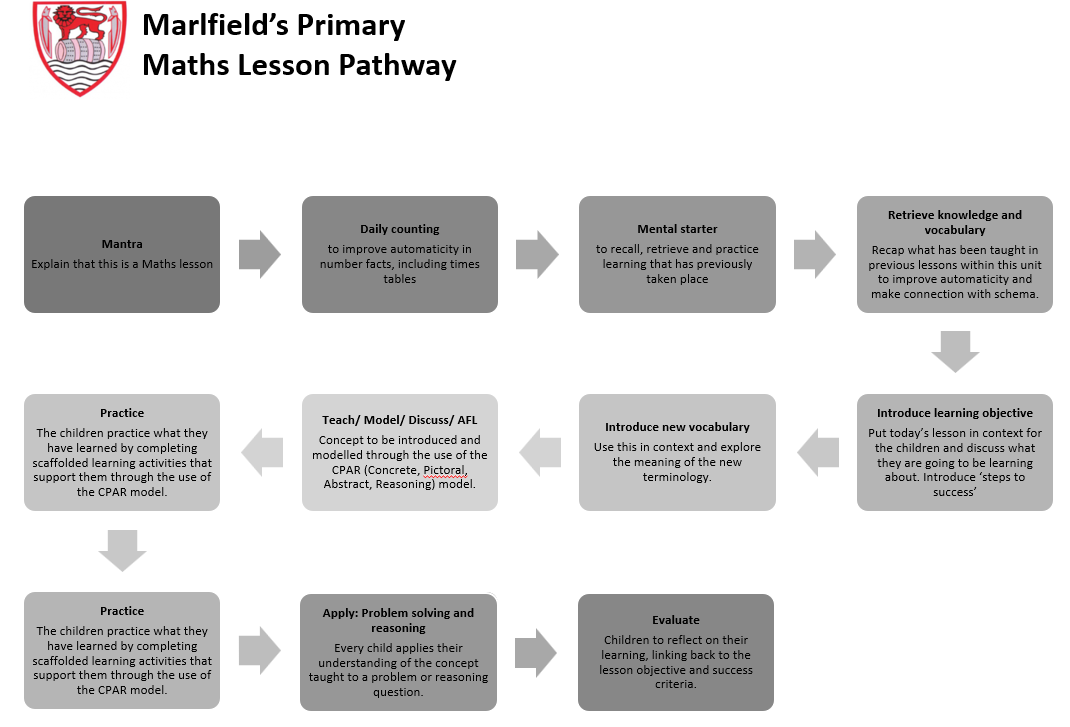
Our Mathematics lesson pathway:
The document below identifies the key elements which we believe are important to incorporate into our Mathematics lessons in order for them to build on previously taught knowledge and also to deepen and secure key concepts.
Click here for our Mathematics Lesson Pathway
Our progressive Mathematics curriculum:
To ensure children are taught and remember the appropriate knowledge and skills relating to Mathematics, we have created a progressive breakdown of the national curriculum expectations. This draws on the skills and knowledge being taught across all subject areas and hopes to contribute to the development of key concepts and themes in a deep and connected way.
Click here for our Mathematics Progressive Curriculum Overview
Subject specific vocabulary:
Our mathematics curriculum will ensure all children are not only taught subject specific vocabulary but also provide opportunities for them to use such language within the correct context with confidence and fluency.
Click here for our Mathematics Subject Specific Vocabulary Progression
Mathematics year group breakdown:
To ensure the highest emphasis is placed on both the teaching and the learning of new knowledge and skills we have also clarified when it will take place within our topics and the subject specific gains our children will make in terms of what they will know and be able to do.
Click here for our Nursery Mathematics Overview
Click here for our Reception Mathematics Overview
Click here for our Year 1 Mathematics Overview
Click here for our Year 2 Mathematics Overview
Click here for our Year 3 Mathematics Overview
Click here for our Year 4 Mathematics Overview
Click here for our Year 5 Mathematics Overview
Click here for our Year 6 Mathematics Overview

 Numicon is an approach to teaching maths that helps children to see connections between numbers. It supports children as they learn early maths skills. It is a multi-sensory way of learning, which means your children learns by seeing and feeling.
 Have you used numbers 0 – 9 to count? Then without even realising, you’ve used base-10! Base 10 is a method of assigning a place value to numbers. It’s also known as the place value number system, or decimal system, as the numerical value of a number relies on where the decimal point sits.
 A ten frame is a simple tool for teaching maths. They help children to develop number sense and early numeracy skills. The more young children encounter numbers and how they interact with each other, the more their number sense and skill grows.
 The part-whole model is the concept of how numbers can be split into parts. Children using this model will see the relationship between the whole number and the component parts. This helps learners make the connections between addition and subtraction.